

Blog · Cabinets
Can You Paint Oak Cabinets Without the Grain Showing?
By the Hollywood Carpentry & Painting team, Bellingham, MA · MA HIC #212730
Published · 7 min read
Short answer
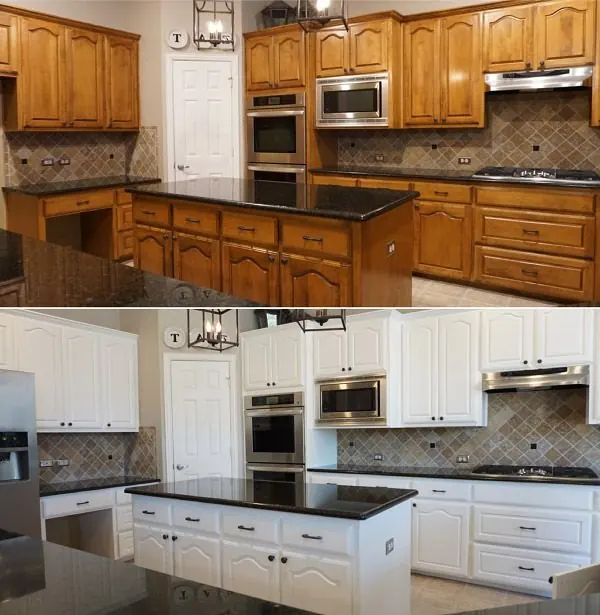
Yes, oak cabinets can be painted so the grain is greatly reduced or nearly invisible, but it takes an extra step. Oak is an open-grain wood, so its pores show through primer and paint unless they are filled before priming. If you like a little texture, skipping the filler leaves a painted-wood look; if you want a smooth, furniture-like finish, ask for grain filling in the written scope.
Key takeaways
- Oak has open pores that telegraph through paint unless they are filled.
- Grain filling is a separate, labor-intensive step that should be listed in the quote.
- A sprayed finish over filled grain gives the smoothest result.
- Some homeowners prefer visible grain; it is a style choice, not a defect.
- Ask to see a sample door or a photo of a finished oak door before deciding.
Why does oak grain show through paint?
Because oak has large, open pores that paint and primer settle into instead of covering flat.
Woods like maple and birch have tight grain, so a primed and painted surface ends up close to smooth. Red and white oak have deep, open pores running along the grain. Paint is a thin film: it follows the surface it sits on, so those pores show as fine lines and texture under every coat. Adding more coats of regular paint softens the look slightly, but it does not fill the pores.
Lighting makes a difference too. Grain is most visible in raking light, for example under-cabinet lights or a window beside the cabinets. A door that looks smooth from across the room can show texture up close in that light, which is why it helps to decide on the look before work begins.
How do painters hide oak grain?
By filling the pores with a grain filler or a high-build primer, sanding it smooth, then priming and painting.
The usual approach is to apply a filler product designed for open-grain wood, let it dry, and sand the surface back so the filler stays only in the pores. Some products combine filling and priming in a heavier-bodied primer that is sanded between coats. Either way, the goal is a flat surface before the color coats go on. This is careful hand work on every door face, frame and drawer front.
Because it adds labor and materials, grain filling should appear as its own line or note in the scope. If two estimates differ a lot on an oak kitchen, check whether one includes grain filling and the other does not. Our guide on comparing estimates covers how to line up scopes like this.
For the bigger picture, read our guide: Refinish or Replace Kitchen Cabinets? How to Decide
Does a sprayed finish make a difference on oak?
Yes. Spraying leaves no brush marks, so the only texture left is whatever grain remains.
On a filled oak door, a sprayed finish is what produces the smooth, factory-like look most people picture. Brushing and rolling can leave marks of their own that combine with any remaining grain. Our cabinet refinishing process removes doors and drawer fronts so they can be prepared and finished flat, which helps both the filling step and the final coats.
The coating matters as much as the method. Cabinets are handled every day, so they need a hard, cleanable finish made for cabinets and trim rather than ordinary wall paint. On oak, the primer also has a second job: oak contains tannins that can bleed through light colors as yellow or brown spots if the primer does not block them. Choosing a primer suited to oak, and letting each coat dry fully before the next, protects both the smoothness and the color of the finished doors.
Is it better to keep some grain visible?
It depends on your style; visible grain reads as painted wood, filled grain reads as smooth and modern.
In farmhouse, traditional or cottage kitchens, a little grain texture can look intentional and honest to the material. In a modern or minimal kitchen, especially in white or a high sheen, grain tends to look busy and many homeowners want it gone. Higher sheens also exaggerate texture, so a satin finish is more forgiving than semi-gloss on oak.
If you are undecided, ask for a sample door or a photo of a finished oak door in your chosen color and sheen. Seeing it under your own kitchen lighting is the most reliable way to decide.
Are oak cabinets worth painting at all?
Usually yes, when the boxes are solid; oak cabinets are often well built and only the finish looks dated.
Many kitchens from earlier decades have solid oak doors and plywood or solid-wood boxes that are worth keeping. Painting changes the look without the disruption of removing and replacing them. If the doors are warped, the boxes are water-damaged or the layout does not work, replacement may make more sense. Our refinish-or-replace guide covers those signs.
| Approach | Finished look | Best for |
|---|---|---|
| Prime and paint, no filling | Visible grain texture through the color | Traditional or farmhouse styles |
| Filled grain, brushed finish | Mostly smooth, possible brush marks | Smaller projects with a softer look |
| Filled grain, sprayed finish | Smooth, furniture-like surface | Modern kitchens and light colors |
Questions to ask before painting oak cabinets
- Is grain filling included, and on which surfaces?
- Will doors and drawer fronts be removed and finished flat?
- What primer is used over oak, and why?
- Which sheen do you recommend for my color and lighting?
- Can I see a finished oak door in a similar color?
Planning this work? See our cabinet refinishing service for what is included, or learn how our process works from estimate to final walkthrough.
Frequently asked questions
Will oak grain show through white paint?
Yes, unless the pores are filled first. White and other light colors in particular reveal texture, so grain filling is worth considering for a smooth white finish.
How many coats of paint hide oak grain?
Extra coats of regular paint soften the grain but do not fill it. Hiding the grain requires a filler or high-build primer that is sanded smooth before the color coats.
Does grain filling add time?
Yes. It is an additional step with drying and sanding on every door, frame and drawer front, so it adds labor to the project.
Which sheen is best for painted oak cabinets?
Satin is often the most forgiving because it shows less texture than semi-gloss while still being easy to wipe clean.
Can you paint oak cabinets that have a glossy finish?
Yes, after thorough cleaning, scuff sanding and a primer that bonds to the existing finish. Proper preparation matters more than the original finish type.